

Written by Julie Winokur
Welcome to Mississippi: Birthplace of American Music. So says the sign on Route 61 heading south from Memphis. This concession to Black creativity ignores a lot of history. The music is the blues, and the sign tacitly acknowledges that our cultural core comes from people we stole from another continent and forced to become our own. Their identity is our identity, in a strange state-sanctioned act of appropriation. I hate saying “we”, because my ancestors had nothing to do with this brutal origin story. But in the spirit of assimilation, I reluctantly own the inheritance of this country. To belong is to share an adopted ancestry and take responsibility for its byproducts, for better and for worse. It may be flawed, but it’s ours.
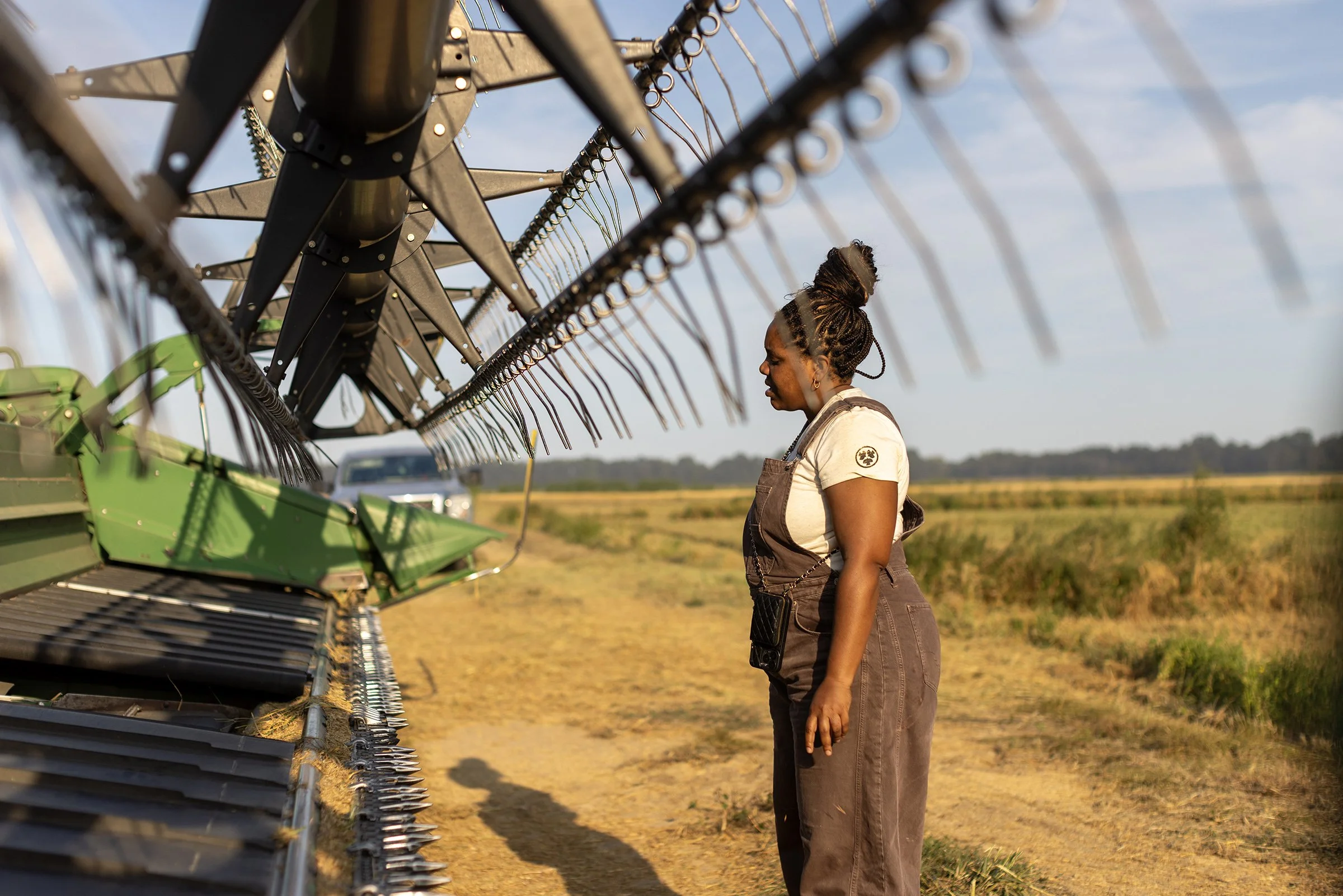
Ed and I drive past carpets of rice in full bloom, casting a glow as though the sunset emanates from the ground and beams upward. Corn stalks, already harvested, decay in the heat like skeletons. We whiz past a massive fiberglass statue of a lumberjack, his arms akimbo, hovering outside Big Boom Fireworks. The Tunica casino entices with the lure of sudden fortune and Blues Trail markers dot the highway like mile markers on the way to Soul Heaven. According to billboards, it’s National Rice Month, a fact that hardly anyone outside Mississippi, Arkansas and California recognizes. Those three states produce 20 billion pounds of rice per year, some of it at the hands of Christi and Robert Miller.
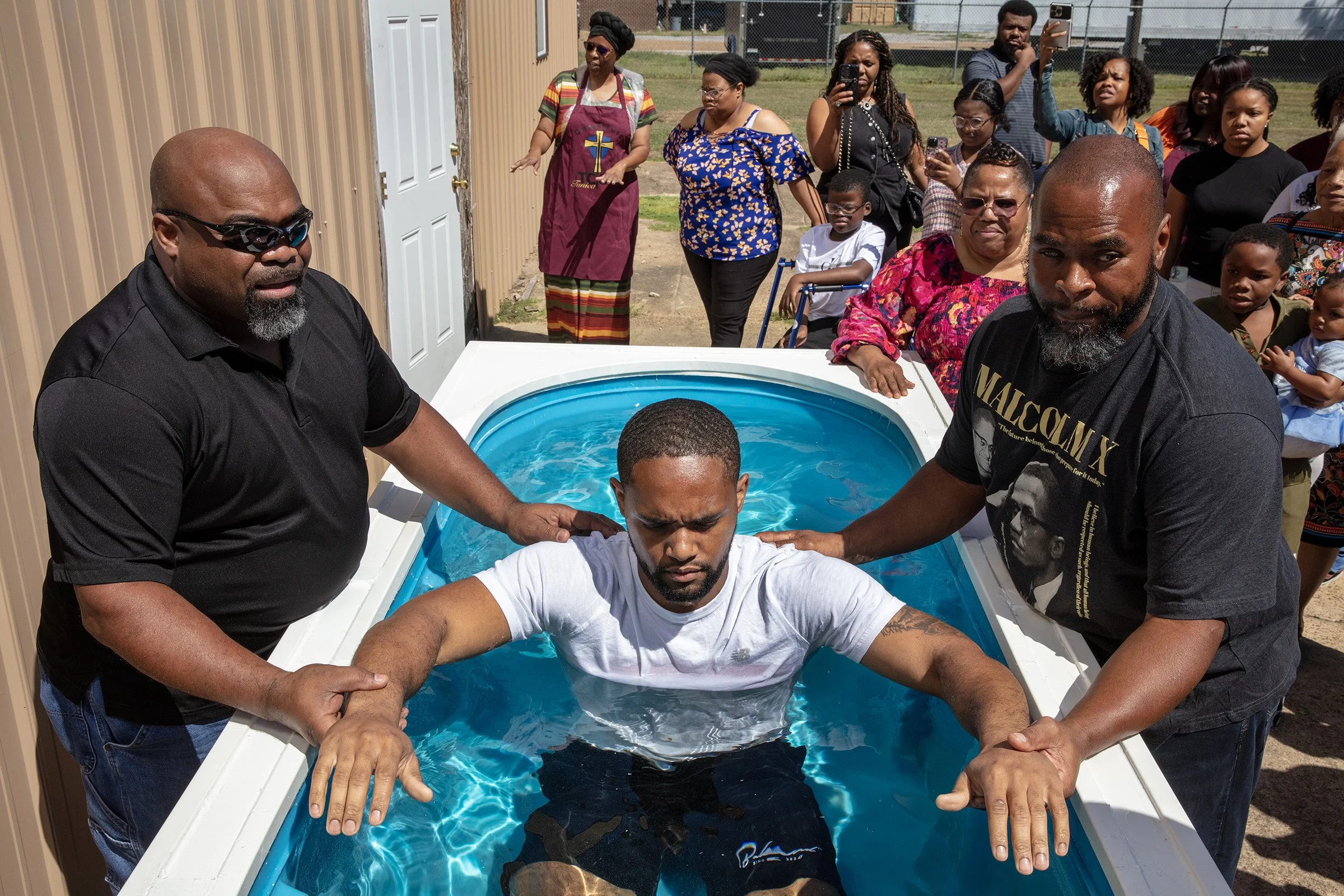
Today, Robert and Christi are hosting a “Farm to Table” event on Vic’s property, although “farm to table” is a misnomer that implies we will be fed a meal grown in their fields. This day will not resemble the tony farm-to-table events in Brooklyn where double degree people who avoid getting their hands dirty eat heavily curated gourmet food that comes from somewhere ‘upstate.’ Very little that is consumed in the Delta is grown in the Delta, despite proud claims that they have some of the richest soil on the continent. Robert and Christi’s event is more like a farm heritage dinner that celebrates Black land stewardship and introduces guests to how their food is produced. The meal today will be served from large aluminum trays and include massive chicken breasts, collards and sweet potatoes. The highlight will not be the meal, but rather a tour of a working field where we’ll learn about the complexity of irrigation, land leveling and the brutal economics of farming.
“As a Black farmer,” I’m a dying breed,” Wayne tells the crowd who have settled onto wooden benches in rows as though they’re attending outdoor Sunday service. In 1930, around when his grandfather bought the land, there were 170 Black farmers in Tunica County and only 107 White. That balance shifted by the 1950s with the dueling forces of Jim Crow pressures pulling them down and the siren call of the North pulling them up. Now, only five Black farmers remain in Tunica County and most of them are Blands.
“This is our heritage,” Wayne tells the congregation. “There are a lot of people that think maybe we shouldn’t be involved in farming, but at one point, that’s all we knew.” The depth of his message courses through those assembled like an electrical current. They’re hearing the gospel of the land, which Wayne imparts through a microphone attached to a small portable speaker that cuts out periodically. His words carry both the humility and the gravitas worthy of a revival meeting, but without the emotional pyrotechnics associated with Southern Baptists. This sermon is fueled by hands-on experience and deep knowledge. Wayne worked for the USDA for many years, so he understands this land intimately from both his heart and his brain.
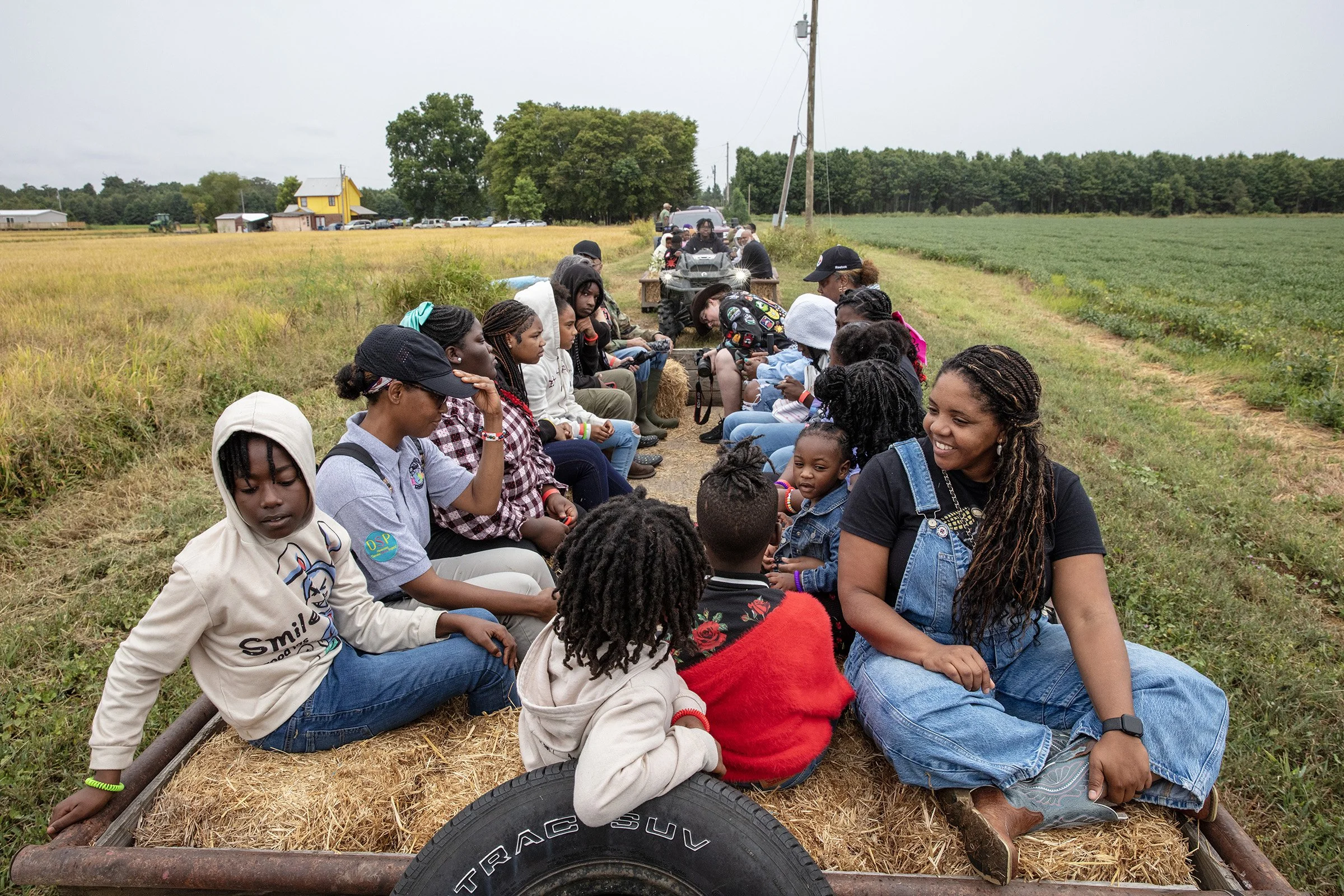
The congregation piles onto three trailers for a short hayride, where uncles, aunts, cousins and kids turn the act of settling onto hay bales into a circus of big personalities overcoming small logistics. Wrangling everyone onto the trailers takes longer than the actual drive to our first stop at the edge of a rice paddy. We hop down off the trailers to learn about what type of rice is being grown (long grain), how long the growing season is (150 days), and how irrigation is essential to the survival of Delta farmers. Without it, a field that could produce 60 bushels per acre might only generate 15. Math is everything here.
~ ~ ~
We follow Robert to the Coronation Day—or Carnation Day, as he says—at Coahoma High School where the homecoming king and queen will be crowned. Robert attends just to help keep the peace if violence should erupt. He knows some of the boys intimately and a recent violent episode has him on edge. We wade through a crowd of teenagers at the entrance that smells like teen lust. All the testosterone has been buttoned into dress suits that are cinched with pastel bowties. This is made all the more necessary since the girls are festooned in floor length gowns that accentuate their curves and cleavage. The girls wear their hair piled high into up-dos or flowing down their shoulders in pressed locks, while the boys sport an impressive range of dreads, braids and fades. We’ve entered a pageant of personalities.
The brightly lit gymnasium has been decorated with pink curtains and a green runway where couples enter to cheers and hoots that gauge their popularity, or at least convey the size of their family. As the girls, cocooned in satin and sequence, take their seats, the boys bow in an incongruous pantomime from some long gone era. Next, a series of queens from various grade levels enter wearing icing-white gowns with hoop skirts, circa 1850. The grand finale involves the crowning of the Queen with a two-foot-high tiara that awkwardly rebels when placed on her head and requires several tries to steady. The king is donned with a poofy red crown which compliments the red robes draped on both of their shoulders. After a brief waltz led by the king and queen, the orderly ceremony devolves into a boisterous scramble to find friends and family. The royal court immediately devolves back into a gymnasium, the fantasy having evaporated instantaneously. Despite having distinctly colonial overtones, the tradition of high school coronations didn’t start until the 1930s, and for the life of me I can’t find a good explanation why. Was it our longing for tradition between the wars? Did it satisfy a need for pomp at a time when the Great Depression had brought us to our knees? And why here, in the South, at a predominantly Black public school in one of the poorest parts of the nation, would students want to pretend they were part of the old aristocracy?
~ ~ ~
Within days of the coronation, a young Black man is found hanging from a tree in Cleveland, the largest town in the Delta. Demartravion “Trey” Reed, a 21-year-old student, was discovered in the early hours of the morning behind the pickleball court at Delta State University. The school immediately announced the Reed had taken his own life. Within hours, the TikTokverse ignited with rumors that his body was battered, with two broken legs. The coroner’s office claimed there was no evidence of foul play, but once an inflammatory rumor finds oxygen, there’s no silencing its corrosive power. While speculation swirls through social media, we risk losing sight of the painful tragedy that resulted in a young man dangling like an ornament from a tree.
Reed’s death comes on the 100th anniversary of the school’s founding. All celebrations are canceled and the school’s administrators are scrambling to do damage control, insisting that the campus is safe and there were no signs of coercion. The coroner took the body away swiftly and now we’re all left to speculate.
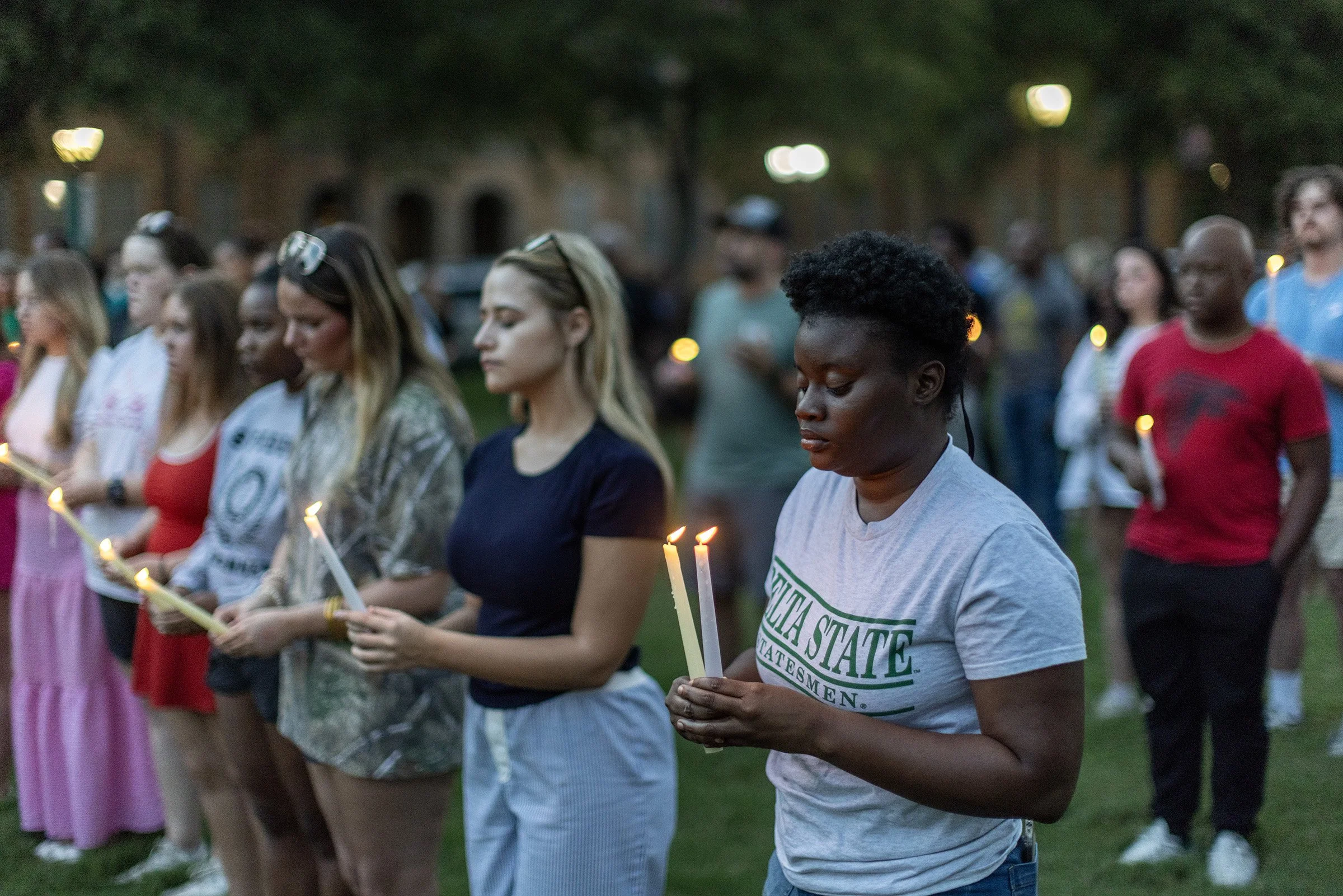
We attend a vigil for Trey Reed where several hundred students and faculty gather on the grassy quad of Delta State University. The heat still holds a grip on the day even as the sun slips away. A student distributes white candles from a cardboard box as the crowd forms a large semicircle. Delta State’s student body is 43% Black and the crowd seems evenly mixed, all dressed in collegiate casual wear from leggings to shorts, baggy t-shirts and baseball caps.
College President Daniel Ennes offers words of solace, asking those assembled to commit to picking each other up when they’re down. As evening settles to darkness, the students’ faces glow in the candlelight, white wax dripping on the forest green grass. Pastor Zack Bryant addresses the crowd with a passage from Philippians 4:8:
Whatsoever things are true, whatsoever things are honest, whatsoever things are just, whatsoever things are pure, whatsoever things are lovely, whatsoever things are of good report, that being virtue, that being praise, think on these things.
“Can you help me just talk to the person beside you and tell them to ‘keep your head?’”
The assembled repeat “Keep your head.”
“At a time like this when it’s so easy to lose our heads, when there’s no much going…anger, fear, all that at the same time, questions a mile long, anxiety, attacks, suspicion, sadness, disappointments, despair. It becomes increasingly difficult to keep it all together. We need some parameters for our mind. We need to build some walls before we lose our minds.
“Somebody say ‘Keep your head.”
Chorus: Keep your head.
“So as we filter through these thoughts, we must first always focus on truth. Not my truth. Not your truth, but the truth.”
“Keep your head.”
Chorus: Keep your head.
“Truth is never too much to ask for. If we’re gonna talk, we’re gonna have a conversation, the very least anyone can give you is truth. Pastor Hodges says it like this: Truth without mercy is mean, but mercy without truth is meaningless. And after the truth, the spirit of abundance reigns. Freedom is always a passenger riding in the vehicle of truth. When truth makes its arrival freedom wakes up, gives truth a tip, gets out the backseat, and the chains that shackle our minds dissipate because it is the revelation of truth that makes us free.
“Somebody say, ‘Keep your head.’”
Chorus: Keep your head.