


Written by Julie Winokur
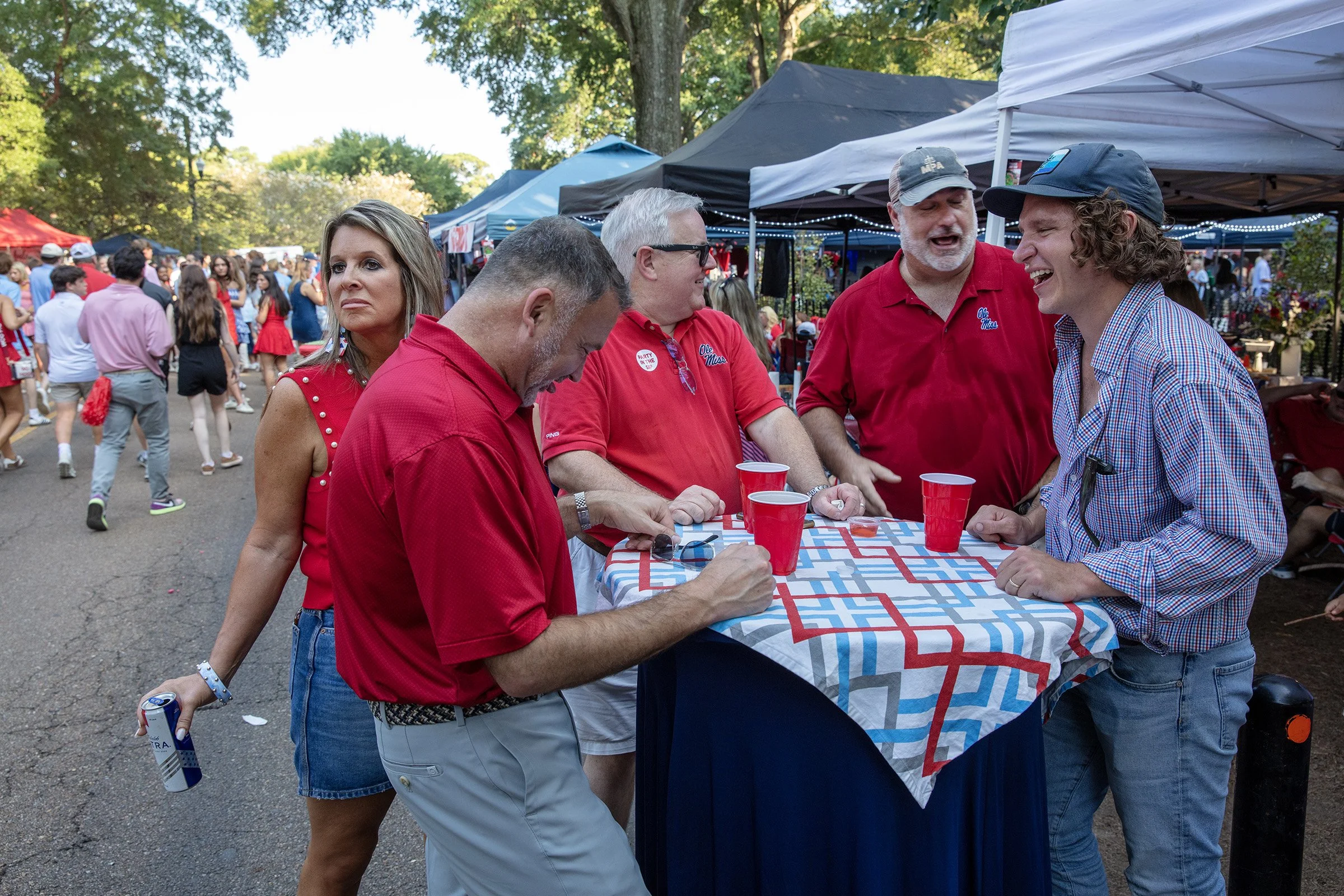
Game day in Oxford, we meet up with Watson and his friends, Jackson, Dalton, Houston and Binky. We pass a drunk frat boy chirping exuberantly, “I can’t wait for the glory of The Grove.” His enthusiasm fills me with dread. A stream of co-eds and alumni in Kodachrome colors move in the direction of the stadium like a gurgling current, churning and swaying as though moved by an invisible force. What started as a pre-game party in the 1950s has metamorphosed into the tailgate Mardi Gras of college football. Hundreds of red, white and blue tents populate a 10-acre plot surrounded by towering elms, oaks and magnolia trees. I should have known it would be a doozy when multiple people said, “You’re going to The Grove?” with raised eyebrows. “That should be fun!” They all flashed a smirk that the initiated give to someone who’s about to lose their virginity.
I have never seen people dress up for a football game before, but the dazzling beauty on parade is hard to ignore. Gaggles of pretty blond girls in short skirts and cowboy boots stream past wearing varying degrees of makeup despite the 95 degree heat. Their carefully curated outfits and determined gates resemble thoroughbred horses, cultivated for displays just like this one. Watson claims the girls at Tulane are next level sexy compared to Ole Miss, because they wear bikini tops on game day revealing more flesh and less modesty. He attributes this to how many Jewish girls from New York let their hair down when they get to New Orleans. The Ole Miss girls are more restrained because their families and family friends are all here to bear witness. The proximity creates natural guardrails to outright hedonism, but truth be told, even with their midriffs covered, seduction is on everyone’s mind.
For some people, the view from The Grove is better than inside Vaught-Hemingway Stadium, which seats 64,000 people. I was told that the party is so good here that fans leave the game early when the score is lopsided so they can pick up where they left off at the tents. Watson jokes, “We may lose a game, but we never lose a party.”
Watson weaves through the maze with a sprinter’s agility, hugging, back slapping and getting a friendly rise out of scores of people. There’s plenty to suggest why The Grove would be the highlight of a college student’s social life. It’s festive, festooned, hormonally activated, adult-sanctioned, daylight debauchery. It’s like a masquerade ball without masks, where play is the point, and if you get too sloppy in the process, all the merrier.
We take a pause on the steps of Farley Hall and Watson asks what I think of the spectacle. He’s caught off balance when I respond that I can’t think of the last time I found myself somewhere with so little diversity. Oxford’s population is 25% Black, but I can count on one hand the number of African Americans I have seen at The Grove. Staring at his feet, he processes what I’ve said as though his photographic memory is processing all of the images from the day. He surveys the situation through fresh eyes and then recounts an incident when he was about three, sitting in church with his parents when his mother asked, “Watson, take a look around you and what do you see?” To which the precocious child replied in a too-loud voice, “A whole lot of white people.”
Watson, with his exquisitely sharp intellectual and social intelligence, is capable of sliding from one world to the other without friction. He does a version of code switching that requires bravado in his White world and righteousness in the Black world. In both, he leans into southern charm, using humor, the great social lubricant, as a means of putting everyone else at ease. He’s a performer who enjoys attention, and he moves at such an accelerated pace that everyone else just gets a glimpse of him whizzing by. His exceptional intellect is camouflaged behind a thick Mississippi drawl and cherubic face.
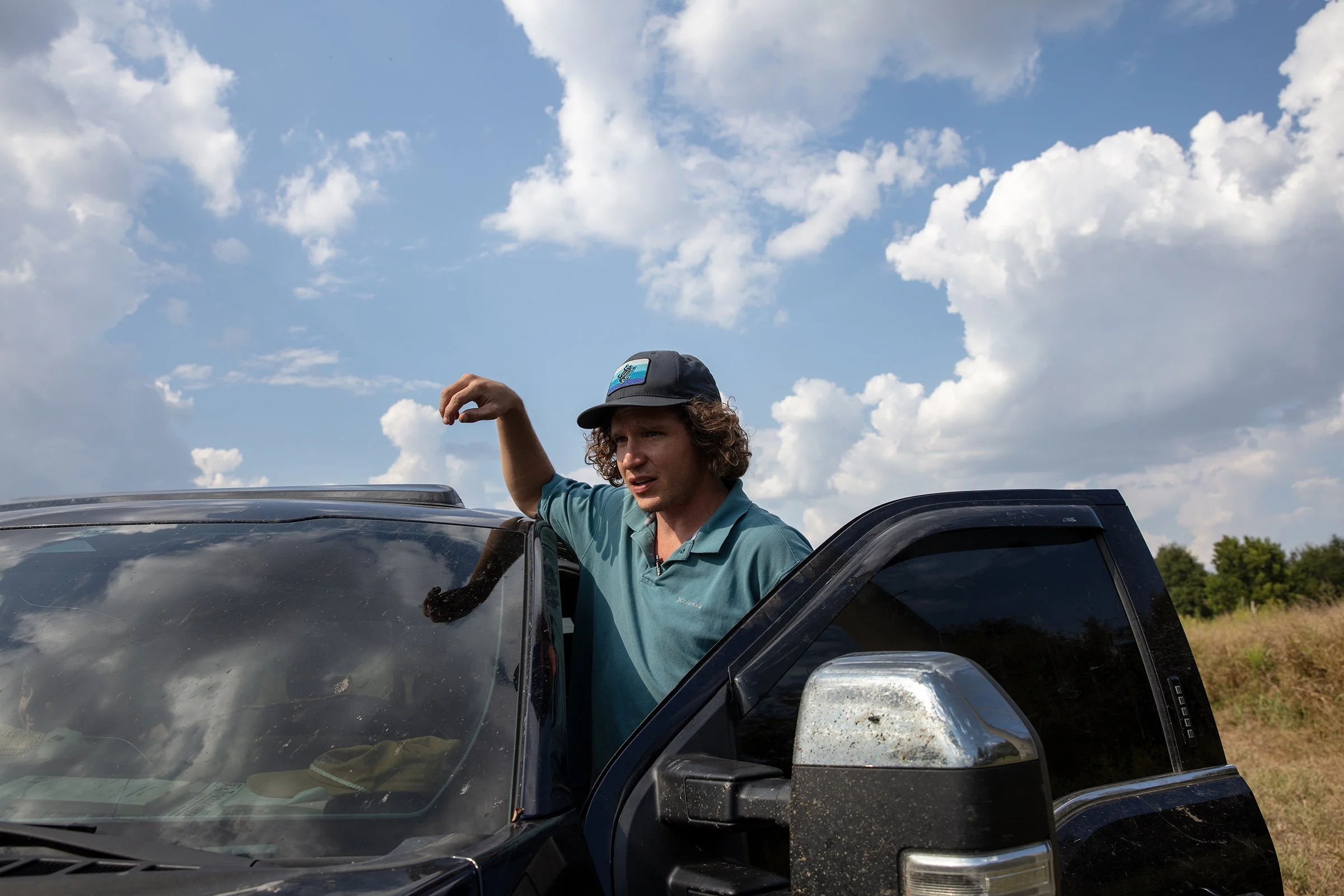
Of all the people we’re spending time with in the Delta, Watson is the most challenging to write about, despite being the most animated. He is mercurial in the way he plunges in and out of situations, pushing himself to excess, searching for his own limitations, which he hasn’t found yet. Already an up and coming lawyer in New Orleans taking on class action lawsuits, he has also become the Tallahatchie County prosecutor back home in Mississippi. As though that weren’t enough, he just agreed to become a public defender for several local towns, including Sumner (although I’m not clear how you can serve as prosecutor and criminal defense attorney, but this is Mississippi after all). As if lawyering weren’t enough, he is also an aspiring farmer, which is just the kind of high risk gamble that would yank his chain. In addition to the 500 acres he rents from Papa Frank, he bought 80 acres this year. With the disastrous market for soybeans under Trump’s tariffs, Watson is on the precipice of losing $100,000 this year alone.
In a rare moment of pessimism the other day, Watson revealed a feeling of defeat. “It’s a moment of reckoning,” he confessed with uncharacteristic seriousness. “I got real blue looking at my farming bills and the interest is ticking. Everyone is in the red and no one knows what the government will do.” He’s heard through the grapevine that the Senate and House are putting together a bailout package like they did last year, but it won’t be enough to stop the hemorrhaging. Last year, Watson received $27,000 from the bailout, but with a $100,000 deficit that’s rising, he finds himself in financial quicksand. Next year’s soybean price, he’s convinced, will be even lower than this year’s.
“I’m watching the commodities markets, the input prices, trying to figure out what to do so this isn’t all for naught. I’m such a perfectionist. I don’t like not being on top.”
This is a staggering moment of vulnerability coming from Watson, whose steely game face, fake-it-til-you-make confidence is convincing. I remain silent as much out of shock as empathy.
“I should have seen it coming, but I’m an eternal optimist. It only hit me two weeks ago. I don’t like floating debt because at what point does it become a black hole? I’ll figure this out. I just have to be smarter than everyone else.”